Using the Web GUI
Create and manage LXC containers through the web interface.
Prerequisites: A registered account and at least one configured site. See Getting Started for account setup.
Logging In
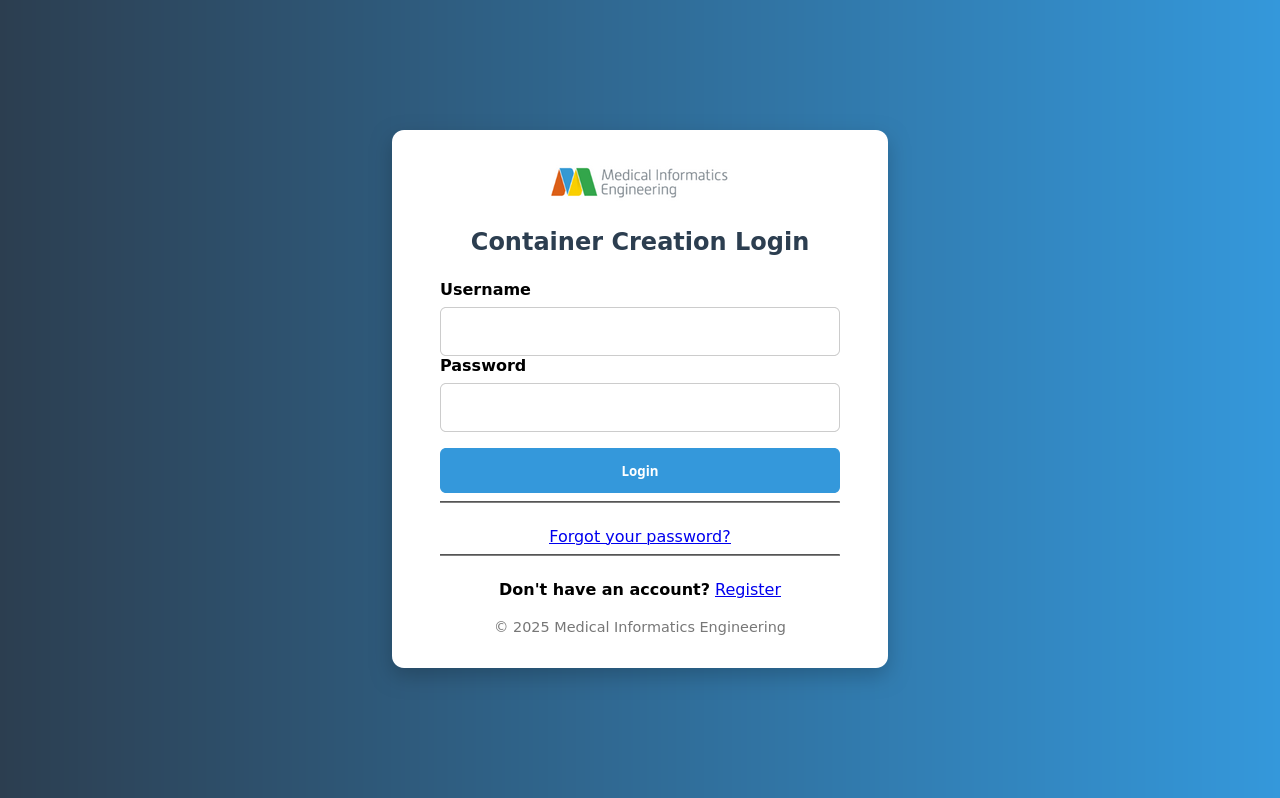
Navigate to the web interface and enter your credentials.
Selecting a Site
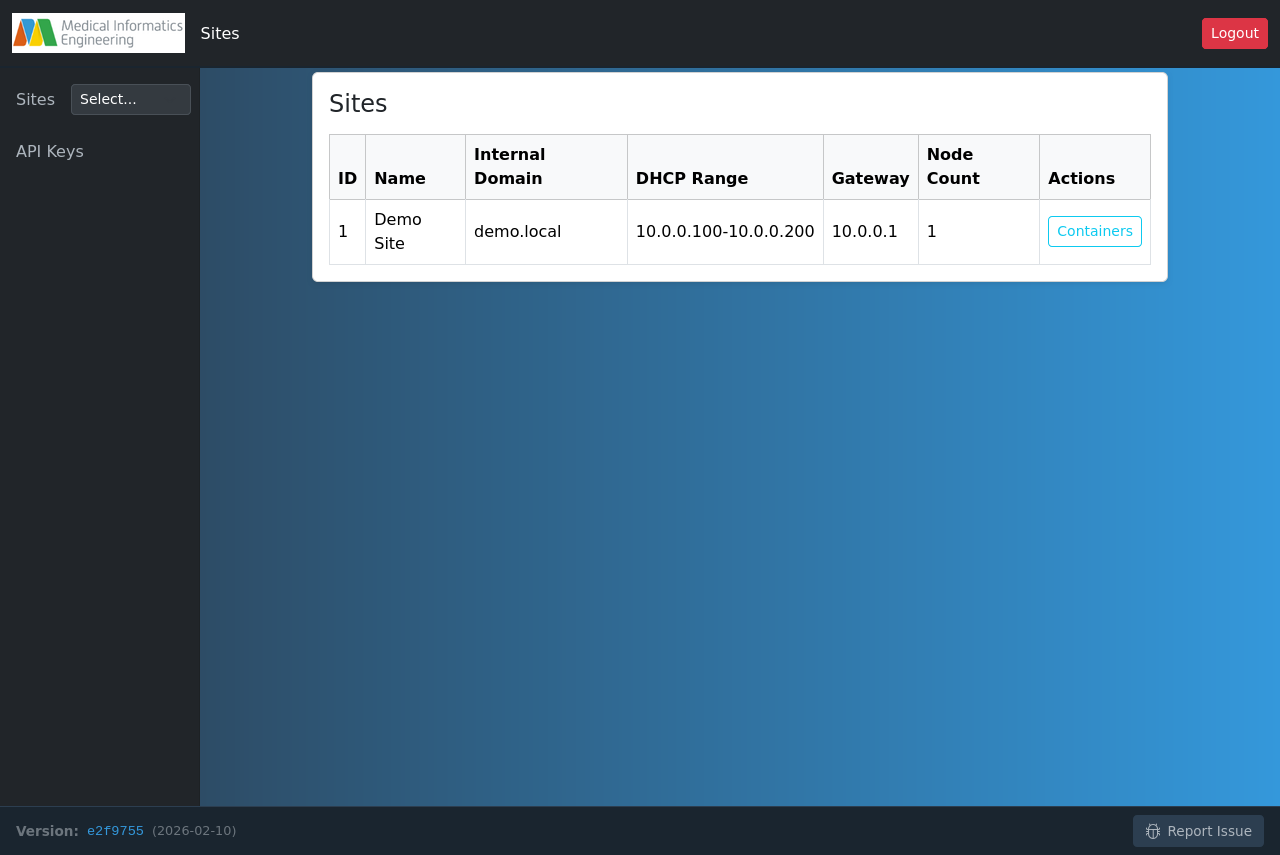
Select a site before creating containers — the site determines the Proxmox cluster and network. Click Containers to view containers for a site.
Creating a Container
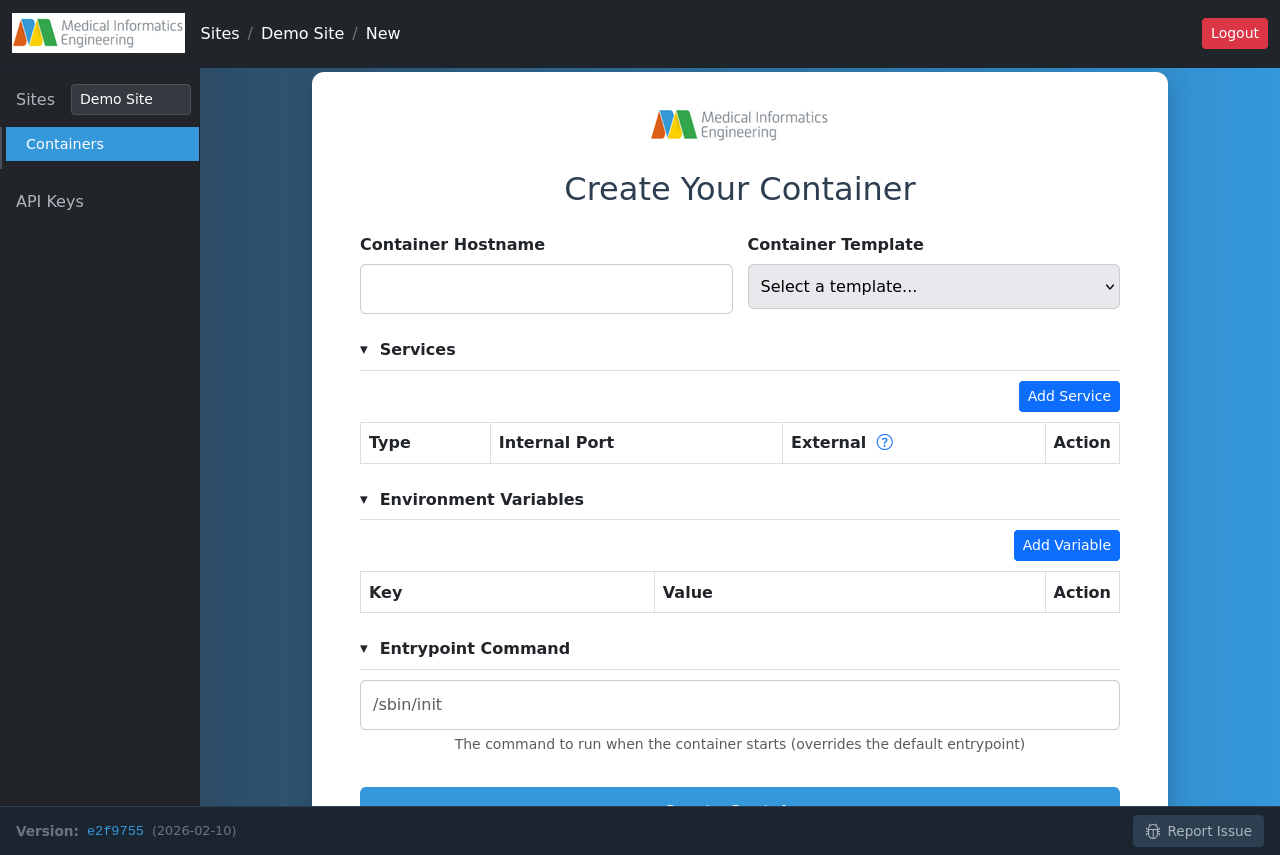
Click New Container from the containers list.
Hostname
Unique name (lowercase letters, numbers, hyphens). Containers within the same site can reach each other at <hostname>.<internal domain>.
Template
Select a standard image or choose "Custom Docker Image..." for any registry image. Temlates auto-populate services, environment variables, and entrypoint.
- Debian 13:
ghcr.io/mieweb/opensource-server/base:latest - NodeJS 24:
ghcr.io/mieweb/opensource-server/nodejs:latest - Debian 13 + Docker:
ghcr.io/mieweb/opensource-server/docker:latest— Docker Engine (CE); every LDAP user can use the Docker socket - NodeJS 24 + Docker:
ghcr.io/mieweb/opensource-server/docker-nodejs:latest - Custom: Full registry path (e.g.,
docker.io/library/nginx:latest)
Services (Optional)
Expose container ports. Click Add Service, select a type, and enter the internal port.
| Type | Description |
|---|---|
| HTTP | Reverse-proxies to the container over plain HTTP. Use when the backend listens on an unencrypted port. |
| HTTPS | Reverse-proxies to the container over HTTPS. Use when the backend terminates TLS itself. |
| TCP / UDP | Maps an auto-assigned external port to the container's internal port. |
| SRV | Creates a DNS SRV record for service discovery. |
Both HTTP and HTTPS services are served to the public over HTTPS with automatic TLS certificates — the type controls the protocol used between the reverse proxy and your container.
HTTP and HTTPS services require selecting an external domain; the hostname defaults to the container hostname. TCP/UDP services are auto-assigned an external port.
Note
You'll need to add a TCP service with internal port 22 in order to expose the SSH connection to your container.
Environment Variables (Optional)
Key-value pairs written to /etc/environment in system containers. See Building Custom Images for details on systemd integration.
Entrypoint Command (Optional)
Default: /sbin/init for system containers.
Warning
Changing the entrypoint for provided templates or derived images is not supported. This should only be used to add arguments to standard Docker images.
NVIDIA GPU (Optional)
If your site has NVIDIA-capable nodes (configured by an administrator), a NVIDIA GPU checkbox appears on the form. Checking it:
- Assigns the container to a node with GPU support
- Sets
NVIDIA_VISIBLE_DEVICES=allandNVIDIA_DRIVER_CAPABILITIES=utility computeautomatically - Attaches the nvidia-container-toolkit hookscript for GPU passthrough
If no NVIDIA-capable nodes are available, the checkbox is greyed out with an explanation. You can override the auto-injected environment variables by explicitly setting NVIDIA_VISIBLE_DEVICES or NVIDIA_DRIVER_CAPABILITIES in the Environment Variables section.
Submit
Click Create Container. You'll be redirected to a page to watch the creation job progress. After the creation finishes successfully, please allow up to 1 minute to allow the load balancer to reconfigure before your services are accessible.
Accessing Your Container
SSH: ssh -p <SSH-PORT> <username>@<hostname>.<domain>
HTTP: https://<hostname>.<domain>
Proxmox Console: https://os.mieweb.org:8006
Managing Containers
- Start/Stop/Restart/Force Stop via the Actions column
- Edit to modify environment variables, entrypoint, or services (restart required)
- Delete to permanently remove (irreversible — back up data first)